
Game info
Word, Spelling, Puzzle
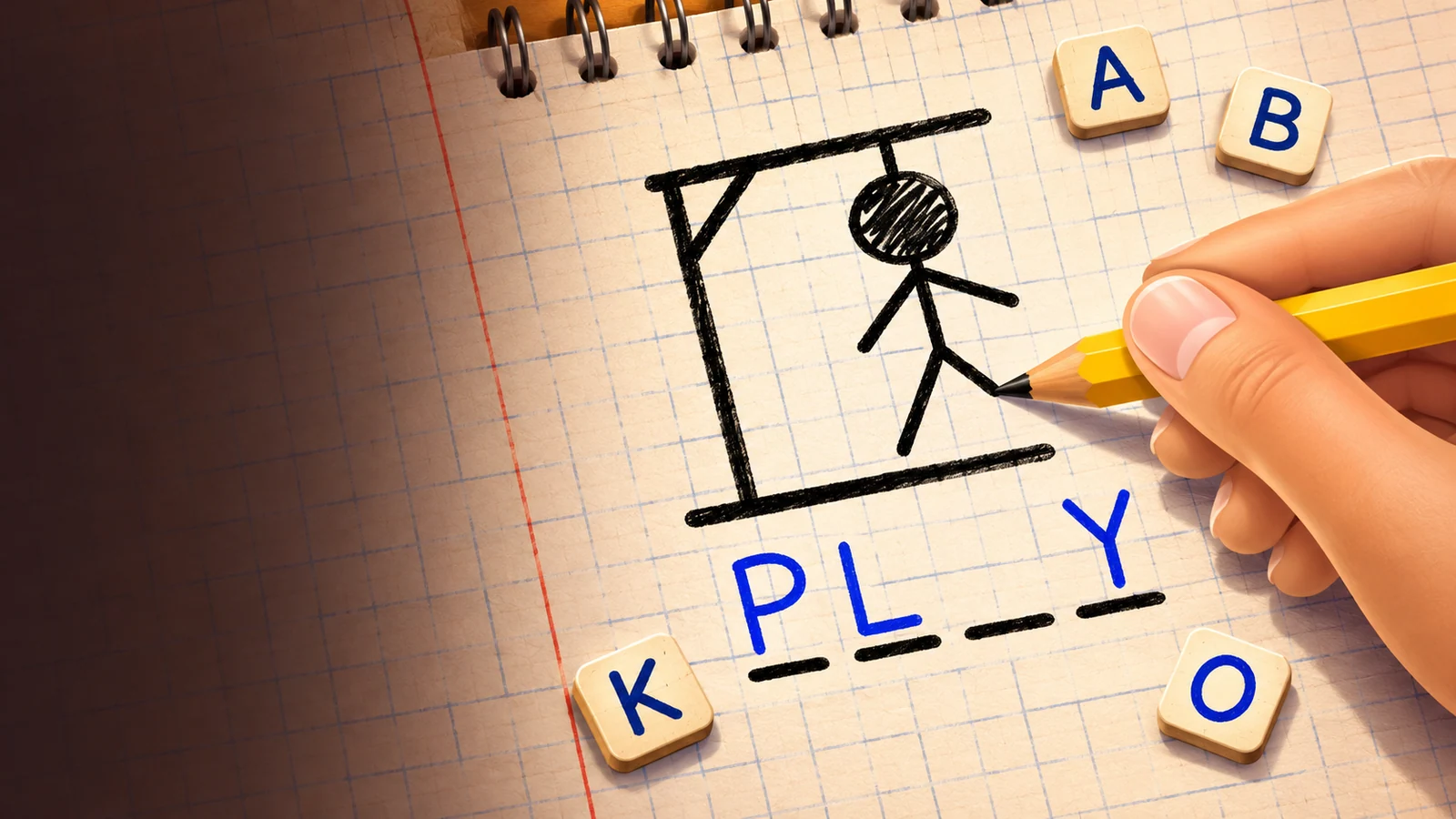
Hangman is a word-guessing game in which each correct letter reveals part of a hidden word and each incorrect guess uses part of a limited allowance. Word length, category clues and the pattern of revealed letters guide the next choice.
About Hangman
Hangman is a word-guessing game in which each correct letter reveals part of a hidden word and each incorrect guess uses part of a limited allowance. Word length, category clues and the pattern of revealed letters guide the next choice.

Gameplay overview
Choose a letter, update the visible pattern and continue until the word is solved or the allowed errors are exhausted. Some digital versions include categories, hints or multiplayer. Those are implementation features rather than universal rules of the traditional game.
How to Play
Start with letters that can distinguish several plausible words. Once a pattern forms, use it instead of continuing through a memorised list of common letters. Check repeated letters and word endings. If a category clue is shown, narrow the vocabulary before spending another guess.
Controls
Browser: click or tap an alphabet key; physical keyboard input where the selected build supports it. Confirm the language of the word list.
Pro Tips
- Confirm the word-list language before starting.
- Use revealed positions, not only letter frequency.
- Consider repeated letters and common endings.
- Check whether a hint costs points or an attempt.
Making Better Decisions
Use each revealed position to narrow a set of plausible words. A common letter is a good early guess when it is likely to reveal useful information, but later the pattern should become more important than a fixed frequency list. Consider repeated letters and endings, and check whether the category points towards a narrower vocabulary. Before spending a scarce hint, decide what uncertainty it will remove. If the word list uses a different language or spelling variety, the same letter strategy may feel unexpectedly weak, so language needs to be visible at the start. Traditional Hangman does not have one universal score system or app publisher. Digital hints, categories, multiplayer and error limits must be described for the selected implementation.
Features, Modes and Progression
There is no single original mobile app or universal publisher to attach to every Hangman domain. Store candidates can be optional related products, not an invented official release.
Use the pattern, not only letter frequency
A common letter is a reasonable starting point, but the visible pattern should change what you consider next. Look at the word length, repeated letters and any category clue. A guess that distinguishes between several plausible words can be more informative than one chosen simply because it is common. Keep track of letters already tried so a remaining attempt is not spent without adding information.
Make an uncertain guess do useful work
When several answers fit, compare which letters they do not share. Choosing one of those letters can reduce uncertainty even if it is absent from the final word. Avoid committing to the first complete word that comes to mind before checking every revealed position. The current version’s dictionary, language and allowed mistakes shape the puzzle, so read those conditions before comparing results between games.
A concrete pattern: choosing between plausible answers
Consider the four-letter pattern _ A _ E. Depending on the dictionary and category, words such as GAME, GATE, LAKE or CAVE might deserve consideration. A letter is useful when it helps distinguish the remaining possibilities. Choosing G tests one part of that set; choosing T asks a different question. The point is not that one example creates a universal best order, but that the known positions should shape the next guess.
Now add a category clue. If the category is places, some candidates become more plausible than others. Check the clue and all revealed positions together. Do not accept a word simply because it fits the number of spaces or was the first answer that came to mind.
Repeated letters and the word list
A repeated letter can reveal more than one position at once. Notice the entire updated pattern before choosing again. A word that once looked plausible may now be impossible because one of its repeated letters would have appeared elsewhere. The display gives information about both presence and position.
The selected implementation's dictionary also matters. Proper names, regional spellings and topic words are not handled identically by every Hangman game. Read the language and category options before comparing results between versions. A traditional word puzzle does not need an invented developer biography, release date or universal difficulty rating. Its interest comes from the real clues: a word length, a pattern, a set of tried letters and a limited opportunity to turn uncertainty into a more precise answer.
The word pattern should change the next guess
Hangman is a word puzzle built from incomplete information. The length of the word, any category clue and the positions already revealed all affect the next useful letter. A common letter can be a reasonable starting choice, but the visible pattern should become more important as the round develops. Guessing from general letter frequency alone ignores information you have already earned.
Check repeated positions. A revealed letter can appear more than once, which changes how possible words fit the pattern. Before committing to a complete answer, compare every known position rather than accepting the first familiar word that comes to mind. One mismatched letter is enough to rule out an otherwise tempting guess.
Make an uncertain letter do useful work
When several words seem plausible, look for the letters they do not share. A guess that distinguishes between those possibilities can be valuable even when the letter is absent. It reduces uncertainty and gives the next choice a reason. This is different from guessing a letter simply because you have not used it yet.
Keep the list of tried letters visible. Repeating a guess without gaining new information wastes attention, even in a version that does not penalise the duplicate. If the game uses a physical keyboard, confirm that the input was registered before trying another key. If it uses on-screen letters, a comfortable screen size helps avoid selecting a neighbouring letter by mistake.
A category clue narrows the kind of word
A clue such as animals, places or food changes which answers deserve consideration. Use it together with the letter pattern. A word that fits the spaces but not the category is unlikely to be a useful candidate. The clue does not eliminate the need to check spelling and repeated letters, but it gives the search a manageable direction.
If the selected game has no category, use the revealed structure instead. Notice possible word endings, common letter pairs and where vowels could fit. Avoid treating one pattern as a guarantee: several words can share an ending. The goal is to build a small set of plausible candidates and choose a letter that helps separate them.
Remaining mistakes change the risk of a guess
Read how many incorrect guesses the selected version allows. Early in a round, an informative letter may be worth testing across several possible answers. Near the end, compare the strongest candidates more carefully before committing. The same letter can have a different value depending on what has already been revealed and how many mistakes remain.
If a round is lost, compare the answer with the pattern you had. Was a category clue overlooked, a repeated letter missed or an alternative spelling unfamiliar? Each is something useful to remember. Learning a new word can be part of the reward rather than treating every unsuccessful round as empty progress.
Language, dictionaries and choosing another word game
Hangman is a traditional game with many implementations. The selected player's language and dictionary determine the answers; a country-specific website does not automatically change an embedded game's word list. Read the player's own language settings when available. Regional spellings and proper-name rules can also differ between versions.
The related collection offers spelling, guessing and other word puzzles. Choose another pattern game if eliminating possible answers is the appeal, or a timed word game if you prefer quick vocabulary recall. Hangman remains interesting because every letter changes what can be inferred. Read the clue, compare the pattern and make the next guess add information rather than merely fill the silence.
Worked example: two answers fit the same spaces
Suppose two plausible words match every revealed position. Compare the letters they do not share. A guess involving one of those letters can distinguish the possibilities even if it is absent from the answer. That makes the choice informative rather than merely frequent. The visible pattern should be narrowing the search as the round develops.
Check repeated letters and the category again before committing to a full word. A familiar answer can feel convincing while violating one revealed position. Rejecting it at that stage is progress: you are using the information already available instead of spending another mistake on a guess the board had ruled out.
Worked example: a useful guess near the final mistake
The remaining allowance changes how much uncertainty is acceptable. Early in a round, a broad informative letter can test several possibilities. Near the end, compare the strongest candidates more carefully. Avoid guessing the first unused letter simply because the game is waiting for an input. A pause to inspect the known positions can add more value than a quick but unrelated choice.
After the answer is revealed, compare it with the clues you had. You may discover an unfamiliar spelling, a missed category connection or a repeated-letter pattern you overlooked. Each is something concrete to retain for the next round. Learning a word is a useful outcome even when the current puzzle was not completed.
Read the dictionary conditions of the selected version
Confirm the player's language and any category or difficulty option. A local-language website does not automatically change a third-party game's dictionary. Some implementations allow proper names or regional spelling; others use narrower word lists. Keep the tried-letter display visible and make sure a keyboard or touch selection registered before making another. The puzzle is most rewarding when each guess adds information and the remaining uncertainty comes from the word itself rather than an unclear input or an assumed dictionary rule.
Related games
Frequently asked questions
What is the best next letter?
Use the word length, known positions and category; a common letter is useful only when it distinguishes plausible answers.
Who develops or publishes Hangman?
Traditional word game; implementation publisher recorded separately
Which controls should I use?
Browser: click or tap an alphabet key; physical keyboard input where the selected build supports it. Confirm the language of the word list.
Can I use my official account or saved progress in a browser alternative?
No account, purchase or save transfer is established unless the developer explicitly documents it for that build.
What games should I try next?
Compare hangman, hangman game, word guessing, spelling games. The related list prioritises shared mechanics and preserves each game’s real identity.
Good game? Tell us.0
Share a tip, celebrate a high score, or tell us what you think. Keep it friendly.